TL;DR – What comms and HR leaders should focus on in 2026
2026 will demand more from leaner comms and HR teams. To drive measurable business outcomes, focus on three essential areas:
Reframe your role: Position comms and HR as performance accelerators, not support functions.
Lead with data: Prioritize business-relevant metrics that tie your work to strategy, retention and performance.
Master strategic storytelling: Use a simple 4-part formula to secure and sustain leadership buy-in.
These strategies showcase your value, simplify your workflows and empower your team to succeed in the face of uncertainty.
You might already be feeling it: the pressure that seemed to peak for internal comms and HR teams in 2025 will stay elevated in 2026. Budgets are shrinking, teams are stretched and leaders want proof that your work moves the needle.
In the year ahead, we encourage you to focus on telling the right story to get and maintain leadership buy-in. We’re here to tell you it doesn’t have to be complicated. The three focus areas below can actually simplify your workflows, remove barriers to action and allow your team to accomplish more in the year ahead.
#1 Changing the narrative around comms and culture to demonstrate value
You know for a fact that the stories you tell and how you tell them matter. This ethos is core to your work. It shows up in the hiring process, your internal comms and your day-to-day interactions with teammates and employees.
But what about the story you’re telling about yourself and your team? If it’s not demonstrating your team’s value, now’s the time to change the narrative.
Reframe your team
Oftentimes, comms leaders have been framed as internal messengers, distributing news and updates. And HR has been framed as a cost center, siloed into process-focused roles that primarily handle administrative tasks.
But HR and comms leaders aren’t just service providers or process movers. You’re a performance accelerator, a mission-critical role that propels the business forward across strategy, engagement and performance.
→ You create alignment, trust and execution at scale.
→ You play a key role in shaping employee experience, from recruitment to offboarding.
→ You have a finger on the pulse of employee engagement, a key factor in retention and performance.
Put your value where the C-suite can see it—it’s key to getting buy-in in 2026.
Rethink the role of culture
Any team in your organization can own strategy and performance, but only comms and HR have the unique ability to own culture. 2026 is your time to show leadership that culture isn’t just a nice-to-have.
Start with the facts: a strong company culture can shift behaviors, drive execution and bring strategy home.
According to PwC’s Global Culture Survey, 72% of workers report that culture enables successful change initiatives. And in a study from SHRM, workers in positive organizational cultures were nearly four times more likely to stay with their current employer.
Your company’s performance is also on the table: data from McKinsey’s Organizational Health Index shows that healthy organizations deliver three times the shareholder returns of unhealthy organizations.
Ask yourself whether your team’s role and impact are well understood by senior leadership. Is your team’s purpose, scope and how you support the business clearly defined and documented? If not, consider creating a team charter and planning a road show early next year to share it with leaders.
#2 Honing in on data to show business impact
Data has two key roles in demonstrating value to leadership. First, data shows where opportunities exist to solve problems, strengthen culture and improve performance. When you aren’t sure of your next move, data lights the path.
Data is also an essential building block to a compelling story. It connects strategy and action to concrete outcomes, demonstrating how your work and the requests you make of leadership are essential to your organization’s success.
Not all data earns a seat at the executive table. Vanity metrics—like email open rates, traffic to your intranet or the number of comms that were sent out about a particular initiative—won’t resonate.
Instead, find the data that threads the needle between your work and relevant business outcomes. Focus on the issues your C-suite cares about—the ones that come up in town halls, 1:1s and shareholder reports.
How to find relevant metrics
To find these metrics, put your skills as a professional communicator to work. Tap into the strong relationships you have across the organization and ask relevant stakeholders for the data you need. It might not happen overnight, but the more you get into the habit of requesting metrics, the easier it will become for you to tie your work to business outcomes.
Here are a few metrics to look for, with examples of how they might appear in your reports.
Cost savings: [X Department] estimates the company has saved $XXX,XXX so far this year
Voluntary turnover: Voluntary turnover has decreased by X% YOY
Customer renewals: X% of customers say they are likely to renew due to faster response times and more consistent service
Sales: Product sales for [X] have increased by X% YoY
Safety incidents: Safety incidents have decreased by X% YoY
Internal comms and HR aren’t the only teams contributing to these business outcomes, but your work did make a difference. Make sure your leadership knows.
Key tip
Whether you’re focused on mission alignment or employee onboarding, make sure to tailor your data to your audience’s top priorities.
→ CEOs are focused on alignment and speed.
→ CHROs are focused on trust and retention.
→ CTOs are focused on efficiency and risk reduction.
Your first step for 2026
Set aside time to audit your current metrics and dashboards. Are they vanity metrics, or do they reflect the priorities of your most important leaders? How can you improve your dashboard of success metrics in 2026?
#3 Using strategic storytelling to gain and sustain buy-in
What’s your current approach to making the business case for culture initiatives? Do your presentations twist and turn from one-off data points to relevant news to blocks of information?
Despite being excellent storytellers, internal comms and HR teams often struggle to relay pain points, strategies and requests in a way that gets the C-suite engaged and on board.
In our latest webinar with Workshop, “How to get leadership buy-in for comms,” our team shared a simple formula for getting and sustaining enthusiastic buy-in.
The four-part formula for gaining buy-in
✅ Hit the pain point (data): What’s the problem your solution will solve? How is it already affecting the business? Tie in relevant business data, and tailor it to your audience.
✅ Preview the possibilities (impact): There’s a better way! Showcase the solution at a high level. How will it impact the organization?
✅ Show ‘em how (strategy): Highlight what you’re going to do (strategy) and how you’re going to do it (tactics). Keep it brief. The exact details, like specific timelines or in-depth explanations, can live in your Appendix, ready to be pulled up if your stakeholder asks for them.
✅ Seal the deal (request/ask): What do you need from leadership? How much will it cost? Once again, keep it simple. You’ve already justified your request by connecting it to business data and outcomes.
How to use the four-part formula to sustain buy-in
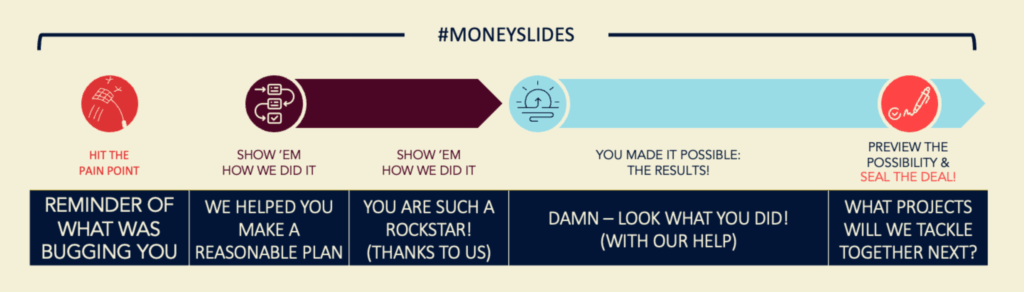
With a few tweaks, this same formula can be used to sustain buy-in on initiatives you want to carry over to the new year. This version focuses on consistently showcasing meaningful progress and reporting out on what you’ve achieved.
✅ Remind them of the pain point (data): What was the pain point you set out to solve? How was it affecting the business?
✅ Show them how it got done (strategy): Summarize the work you’re doing, and the strategy and tactics that have supported it.
✅ Preview the results (impact): What wins can you show off? Make sure to focus on business-driven metrics that reflect the pain point you presented earlier.
✅ Seal the deal (your brilliant ideas to keep it going): Share a high-level overview of your plan to maintain success and the resources you need to make it happen.
These formulas work because they’re simple: they connect your work to real business pain points and showcase your team’s ability to have an impact on issues C-suite leadership cares about.
Your first step for 2026
Outline your team’s proudest achievement from 2025 and your most ambitious initiative for the year ahead using these two frameworks. How does this positioning enhance the story you’re trying to tell? How could you apply it to other requests?
Thinking beyond 2026
2025 was a year of massive change at many organizations. Between AI, layoffs and industry mergers, many teams spent most of the year just trying to get by. 2026 will be no different. Instead of getting stuck in the weeds, take the opportunity to own this moment. Your goal in 2026 is to see the forest for the trees and focus on the fundamentals.
To do that, you need to reframe your team’s role, solve problems using real data and successfully gain buy-in. These are frameworks you can use no matter what the year throws your way. And done well, these focuses will lead to positive change for your organization, team and work for years to come.
FAQ: What comms and HR leaders need to know for 2026
What’s the biggest challenge for comms and HR leaders in 2026?
Leadership teams expect measurable outcomes from leaner HR and comms teams. The challenge is proving value while navigating tight budgets and strategic shifts.
How can HR and comms reframe their role?
HR and comms need to shift the narrative from “internal service” to “business performance driver.” Teams should clearly define their scope and share a team charter that connects their work to culture, engagement and execution.
Which metrics matter most to leadership?
Focus on data that connects directly to business outcomes: cost savings, voluntary turnover, safety incidents, customer renewals and employee retention. Vanity metrics, like email open rates or intranet traffic, won’t reflect your value.
What’s the most effective way to get leadership buy-in?
Use the 4-part storytelling formula: 1) Identify the business pain point, 2) Preview the impact, 3) Show the strategy and 4) Make the ask. This framework is simple, repeatable and aligned with executive decision-making priorities.
Where should HR and comms teams start in Q1 2026?
Audit your current dashboards and comms. Are you measuring what matters to your CEO, CHRO or CTO? Create a team charter, align metrics to leadership priorities and use strategic storytelling to drive initiatives forward.