An edited Q&A with bink’s VP of Research and Strategy on what the Culture at Work Study’s four mindsets reveal about leadership, systems, authority and trust.
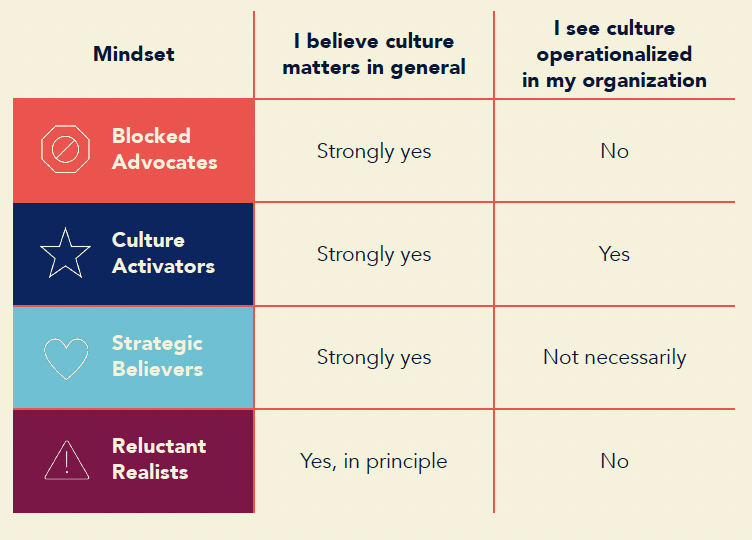
Four distinct mindsets emerged from the results of our Culture at Work Study: Blocked Advocates, Culture Activators, Strategic Believers and Reluctant Realists.
Industry, company size and revenue did not explain why someone landed in one group versus another. Instead, the differences pointed toward something more interesting: how practitioners experience leadership, whether the systems around them reinforce the culture their organization says it wants and how much authority they have to influence those conditions.
The statistical segmentation was conducted by our research partner, Audience Audit. Once these groups emerged, we wanted to understand what they mean in practice.
Ann Melinger, CEO of bink, sat down with Becky Sennett, bink’s VP of Research and Strategy, to unpack what the four mindsets can teach us about why culture works in some environments, stalls in others and what leaders can do with that information.
Understanding the four mindsets
Ann: What does this segmentation help us understand that the topline findings alone can’t?
Becky: One of the most striking things about the research was how much agreement there was.
Across the study, 91% of respondents agreed that a disconnect between leadership messaging and leadership behavior is one of the most damaging cultural forces inside organizations. Ninety-five percent agreed organizations navigate change better when leadership behavior, systems and messaging are aligned. Ninety-four percent agreed leadership alignment is an important driver of organizational performance. So there really isn’t much disagreement among practitioners about what good looks like.
Segmentation helps us understand why that shared belief doesn’t always produce the same experience. Some practitioners are working in environments where leaders, systems and incentives generally reinforce what the organization says it values. Others can see exactly where those things are misaligned but have very little authority to change them.
The topline findings tell us what people believe. The segments help us better understand the organizational reality practitioners are experiencing.
Ann: If all four groups agree on the fundamentals, what actually separates them?
Becky: The biggest difference between the groups is what they’ve experienced within their organizations.
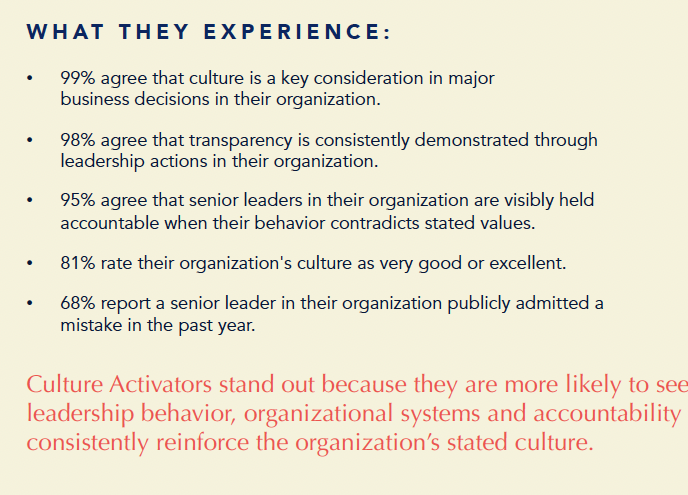
Culture Activators generally report seeing evidence that the organization is following through on stated commitments to culture. Leaders are accountable. Incentives reinforce stated values. Culture influences real business decisions.
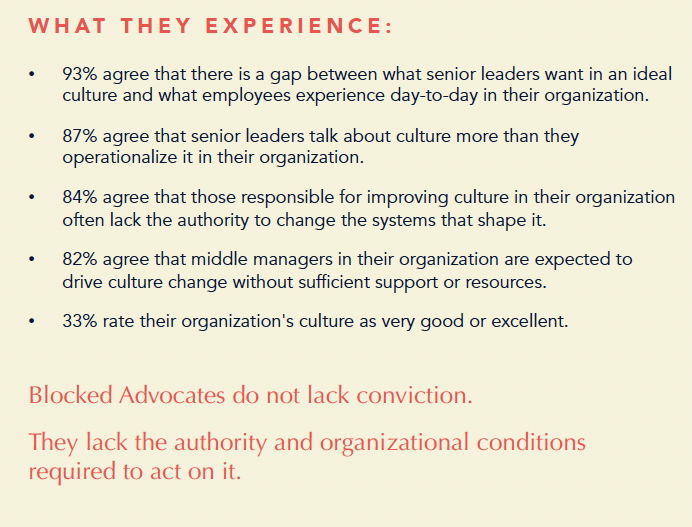
Blocked Advocates may believe just as strongly in the work, but they’re experiencing something different. They can see what needs to change and often don’t have the authority to change it.
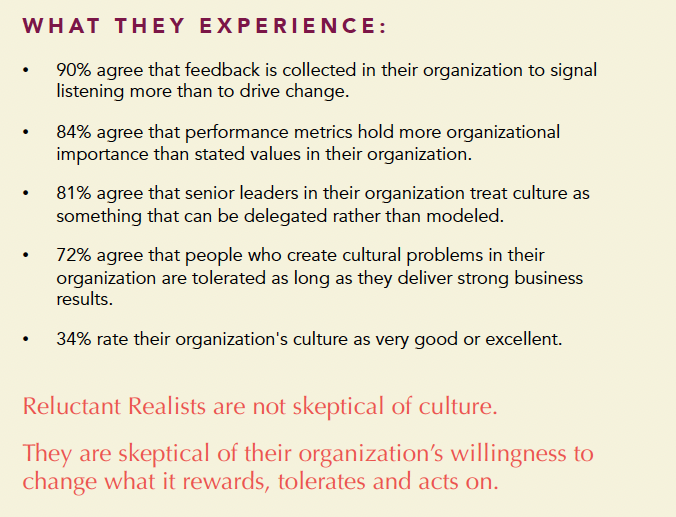
Reluctant Realists believe culture matters too. But they’ve accumulated enough evidence to be skeptical that their organization is willing to act on its own words.
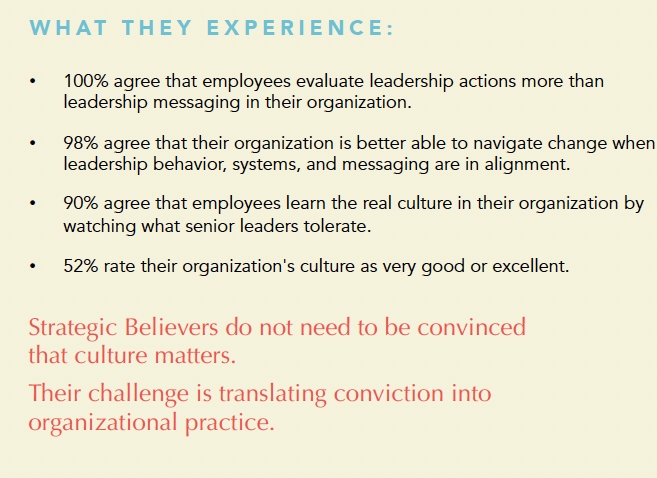
Strategic Believers sit somewhere else. Their conviction about the importance of culture is incredibly strong, even when their organization isn’t fully operating that way.
So, this isn’t really a story about who cares most about culture. It’s about what people have learned by watching their organization operate.
Ann: Why is it meaningful that industry, company size and revenue didn’t explain which mindset someone held?
Becky: I think it’s interesting becauseit means these experiences aren’t reserved for a certain kind of company.
The study included respondents across industries, at various revenue levels and organization sizes, yet these factors did not correlate with the differences we observed between the groups.
What the mindsets look like in practice
Ann: Let’s start with Blocked Advocates. What might someone in this group be experiencing?
Becky: Imagine someone leading Internal Communications at a company that says collaboration is one of its core values.
Their team reinforces collaboration in leadership messaging. HR may have added it to performance expectations. But the business still rewards individuals for hitting their own goals, not teams – and certainly not cross-functional teams. Leaders might also tolerate behaviors that undermine collaboration as long as someone delivers results.
This practitioner sees the contradiction clearly. They may even know exactly what could help address this gap, but they don’t have authority over incentives, promotion decisions, or leadership accountability. In fact, 84% of Blocked Advocates agreed that the people responsible for improving culture often lack the authority to change the systems shaping it. They’re highly concentrated in Internal Communications and HR while having the lowest executive leadership representation of any segment.
Ann: What does a Culture Activator experience differently?
Becky: With Culture Activators, there’s more consistency between what the organization says and what employees actually observe. Maybe transparency is a stated value and then a senior leader openly acknowledges a mistake. Perhaps culture is regularly discussed at the board level. Promotion and advancement decisions actually reflect the behaviors the company says matter.
Those actions build credibility because employees don’t have to rely entirely on the message. They can see the culture in the decisions being made.
Several conditions stood out among Culture Activators: public leadership accountability, board-level conversations about culture, incentives aligned with stated values and more consistent measurement.
Ann: Strategic Believers can sound a lot like Culture Activators. What’s the difference?
Becky: I think of it as conviction versus experience. Strategic Believers have an incredibly strong belief that culture is a business lever. In some cases, their conviction is even stronger than Culture Activators’. But their organization may not consistently operate in a way that reflects that belief.
A Culture Activator can look around and say, ‘This is how things generally work here.’ A Strategic Believer is more likely to say, ‘This is how I know things should work.’
The opportunity for Strategic Believers could be to pull back on spending so much energy on making the philosophical case for culture and instead steer conversations toward the specific organizational conditions that need to change for their belief to become reality.
Ann: And what makes a Reluctant Realist a realist rather than a cynic?
Becky: That distinction is really important. Reluctant Realists still believe the same fundamental things about culture as the other groups. Their skepticism isn’t about whether culture matters. It’s about whether their organization is willing to act.
They may have watched employee feedback get collected without meaningful follow-through. They may have seen high performers rewarded despite behavior that contradicts stated values. They may hear leaders talk about transparency while simultaneously avoiding difficult information. After enough of those experiences, skepticism is understandably common. What leaders should do with this
Ann: Taken together, what do these four mindsets tell us about why culture work stalls?
Becky: The clearest takeaway for me is that culture work stalling isn’t because of a knowledge problem.
Respondents know leadership behavior matters. They know incentives matter. They know employees pay attention to actions.
The breakdown happens when the systems around those beliefs point somewhere else.
Across the full study, 54% of respondents said the people responsible for improving culture often lack the authority to change the systems shaping it. Sixty-eight percent agreed structural systems matter more than messaging when shaping culture.
In most cases, the people doing this work may already know exactly what the problem is, but they lack the authority to change what’s causing the issues.
Ann: Is the goal to move from one mindset to another?
Becky: I wouldn’t think about the segments as a maturity ladder. The goal isn’t to turn everyone into a Culture Activator. I think the more useful question is: What conditions are producing the experiences people are having?
If there are Blocked Advocates, what authority or support are they missing? If there are Reluctant Realists, what has happened repeatedly enough to earn that skepticism? If Culture Activators are thriving, what is working that should be documented and protected before the organization goes through a major change?
Ann: If someone recognizes themselves as a Reluctant Realist or Blocked Advocate, for example, what should they do with that insight?
Becky: I’d say start with one thing. Culture work can become overwhelming because everything feels connected. Leadership, communication, incentives, managers, promotions, performance systems — it’s a lot. So don’t start by trying to ‘fix culture.’ Pick one real decision.
Maybe it was a promotion. A recognition decision. A performance conversation. A leadership response when something went wrong.
Then ask yourself three questions:
What did we say we value?
What did this decision actually reward or reinforce?
What did employees learn from the difference between those two things?
That, I think, turns culture from an abstract conversation into something observable.
And for practitioners who don’t have authority over every system, the research validates that reality. The answer isn’t to take on even more accountability.
But HR and Communications practitioners often have incredible visibility across an organization. They can spot contradictions. They can bring employee evidence into leadership conversations. They can coach leaders. They can help connect values to how decisions are explained, and they can help the people who do have authority see the gaps more clearly.
Sometimes the first move isn’t changing the whole system. It’s having one better conversation about what the system is currently reinforcing.
The takeaway
The four mindsets aren’t labels to assign to practitioners. They’re a way to understand the organizational realities we work within and to make sense of the widely varied experiences we have in doing this important work. It’s less about “which mindset should I have?” and more about “what’s led me to feel this way – and what could that tell me about what needs to change in my own organization?”
The Culture at Work Study suggests the path forward starts there: a closer look at the behaviors, decisions and systems shaping the culture employees actually experience.
Downloadthe full Culture at Work Study to see the four mindsets, the five major findings and the organizational conditions associated with stronger culture alignment.